
kuz.

episode · perception

Do you ever actually see the present?

Light, sound and nerve signals all take time. By the time you perceive "now," it is already gone.

Thumbnail for Do you ever actually see the present?

The short answer

You never perceive the present. Touch your nose and your toe at the same time and you feel them together, even though the toe signal has further to travel and arrives later: your brain waits for the slow one and binds them. Light and sound take time to reach you, and your brain then needs tens of milliseconds more to build a conscious picture, so what you call 'now' is already a fraction of a second in the past. The same lag scales to the sky. The sun you see is about eight minutes old, the stars are hundreds to thousands of years old, and some burned out long ago. From dead starlight to your own hand, you have never once touched the present moment.

Transcript

Touch your nose and your toe at the same time. You feel them together. You shouldn't.

Your toe is over a metre further from your brain, so that signal arrives later. But your brain waits for it, and lies that they happened at once.

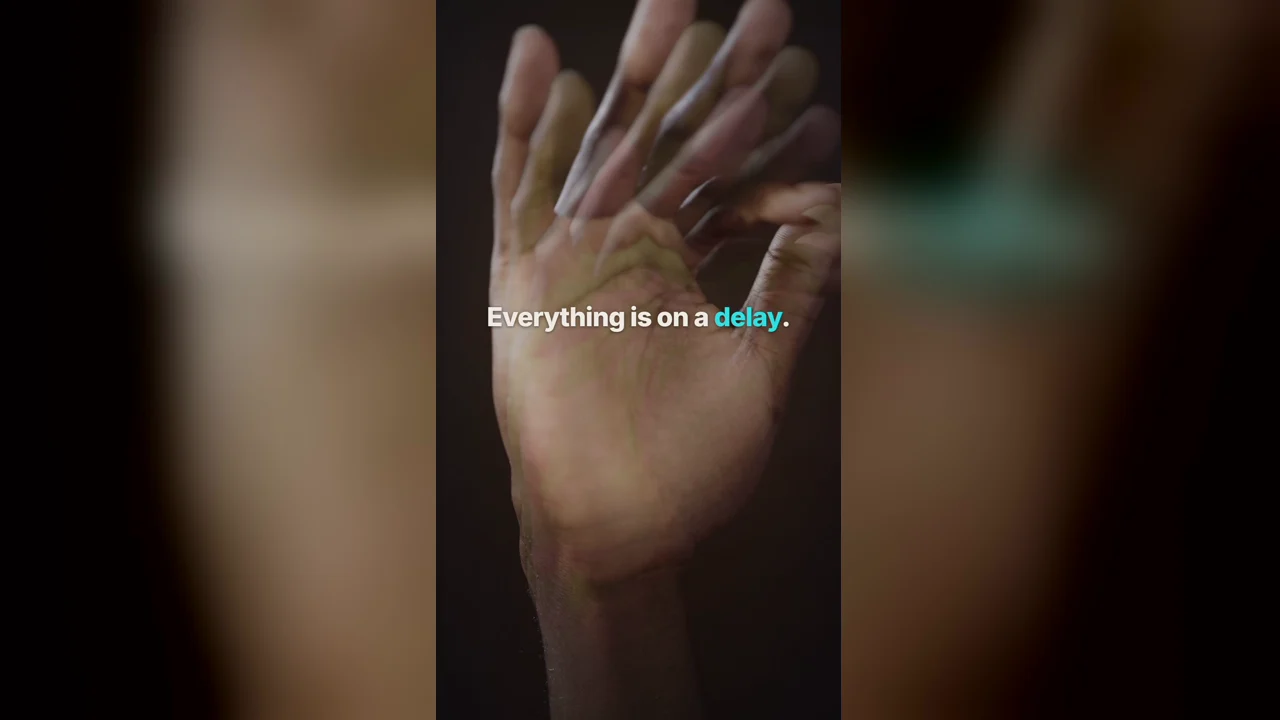
Everything you experience is on a delay. By the time you're aware of "now," it's already about eighty milliseconds in the past.

You're not living in the present. You're watching a replay.

And it gets worse. The sun you see is eight minutes old. The stars, thousands of years old. Some burned out long ago.

You are seeing ghosts.

From dead starlight to your own hand, you have never once touched the present moment. And you never will.

Sources

  1. Amano, K., Goda, N., Nishida, S., Ejima, Y., Takeda, T., Ohtani, Y. (2006). "Estimation of the Timing of Human Visual Perception from Magnetoencephalography." Journal of Neuroscience, 26(15), 3981-3991. Used MEG to time when a visual percept is actually established in the brain relative to the stimulus, confirming that conscious perception trails the physical event by a measurable delay rather than happening instantaneously. Open source
  2. Inui, K., Kakigi, R. (2006). "Temporal analysis of the flow from V1 to the extrastriate cortex in humans." Journal of Neurophysiology, 96(2), 775-784. Tracked the wave of visual processing as it spreads from the primary visual cortex outward, showing that even the first cortical responses to light arrive tens of milliseconds after the eye is stimulated, the lower bound of the "you live in the past" delay. Open source
  3. Whalley, B., et al. "Neuroanatomy, Unmyelinated Nerve Fibers." StatPearls, NCBI Bookshelf. Documents nerve conduction velocities: slow unmyelinated C-fibres conduct at roughly 1 m/s and faster fibres many times quicker. Because a touch on the toe must travel about a metre further than a touch on the nose, its signal reaches the brain noticeably later, the physical basis for the temporal-binding demonstration. Open source
  4. Eagleman, D. M., Time Perception research, Eagleman Laboratory (Stanford / Baylor College of Medicine). Investigates how the brain assembles a "temporally unified picture of the world" from signals that arrive and are processed at different speeds, including how the brain waits for slower inputs and synchronises them, the binding mechanism behind feeling a nose-touch and toe-touch as simultaneous. Open source
  5. NASA Space Place. "What Is a Light-Year?" NASA Science (jet-propulsion / public science education). States that the Sun's light takes about 8.3 minutes to reach Earth, and that starlight has travelled for years to centuries, so the night sky shows objects as they were in the past, some of which no longer exist. The cosmic-scale version of perceptual delay. Open source

related

other things you've googled.

follow kuz for the next answer.

Follow kuz on YouTube